
Saving freshwater
Saving freshwater at sea
– every liter counts in modern sailing
At first glance, sailors are surrounded by an unlimited supply of water. However, beneath this impression lies a growing global challenge: the shortage of freshwater, one of the planet’s most valuable and increasingly threatened resources. Across the world, droughts, rising temperatures, and growing pressure on natural resources are reshaping how we think about water consumption, also in recreational sailing. Modern seamanship is therefore no longer defined solely by navigation skills or respect for weather conditions, but also by the ability to use freshwater responsibly and understand the environmental impact of every liter consumed at sea.
The global context: a growing freshwater crisis
Freshwater scarcity is no longer a distant concern. It is a present and accelerating global challenge. According to the European Environment Agency, around 30% of Europe’s territory and 34% of its population experience water stress in an average year (EEA). Moreover this situation is expected to worsen due to climate change. Rising temperatures, shifting precipitation patterns, and more frequent droughts are reducing water availability across the continent. It is also clearly stated that “Europe’s water management practices are poorly adapted to managing rapid and extensive change, compromising the EU's water resilience” (EEA).
Poland is not an exception from this trend. Despite a common perception of water abundance, Poland has relatively low freshwater resources per capita compared to other European countries, what earned it a nickname “dry man of Europe” (European Commission). Poland’s renewable freshwater availability amounts to approx. 1,400-1,460 m³ per person annually (since 2000), depending on the year and hydrological conditions (World Bank data).
By comparison, the European Union average exceeds 3,000 m³ per person, while countries such as Sweden or Finland have more than 16,000-19,000 m³ per person annually. Experts generally classify countries with less than 1,700 m³ per capita per year as being under water stress. Increasingly frequent drought periods, especially during summer, lead to falling groundwater levels, reduced river flows, and local water shortages, as well as increased risk of flooding.
The water cycle meets the sailing life
For sailors, freshwater crisis means that water is not just a logistical concern but it should be seen as a part of a broader environmental issue. Water used onboard becomes part of a cycle as it is transformed into what is known as graywater. Graywater includes wastewater from kitchens, showers, sinks, and laundry. On boats, every liter used for cooking, washing, or cleaning enters this category.
This has two important implications:
1. Every drop used becomes wastewater that must be managed.
Whether discharged at sea (where regulations allow), stored onboard, or pumped out in marinas, graywater must be handled responsibly to avoid environmental contamination.
2. Treating greywater requires energy.
Wastewater treatment, either onboard in advanced systems or ashore in municipal facilities, is energy-consuming. This means that in the global scale excessive water use indirectly contributes to greenhouse gas emissions and climate change. In this sense, saving water is not only about conserving a scarce resource but also about reducing energy demand and carbon footprint.
Water use in sailing: small actions – large impact
On a yacht, water consumption is often invisible until tanks run dry. Typical daily usage during short cruises is approx. 25-40 liters per person, depending on habits and equipment. Showers, dishwashing, and deck cleaning are the main contributors.
Yet small habit changes can significantly reduce consumption:
- Turning off taps while soaping dishes or brushing teeth,
- Using seawater for pre-washing where possible,
- Installing low-flow faucets and showerheads,
- Fixing leaks immediately,
- Planning water usage before longer passages.
Each litter saved onboard reduces not only immediate demand but also the downstream burden of wastewater treatment.
Innovation in practice: Västervik’s Smart Water Marina
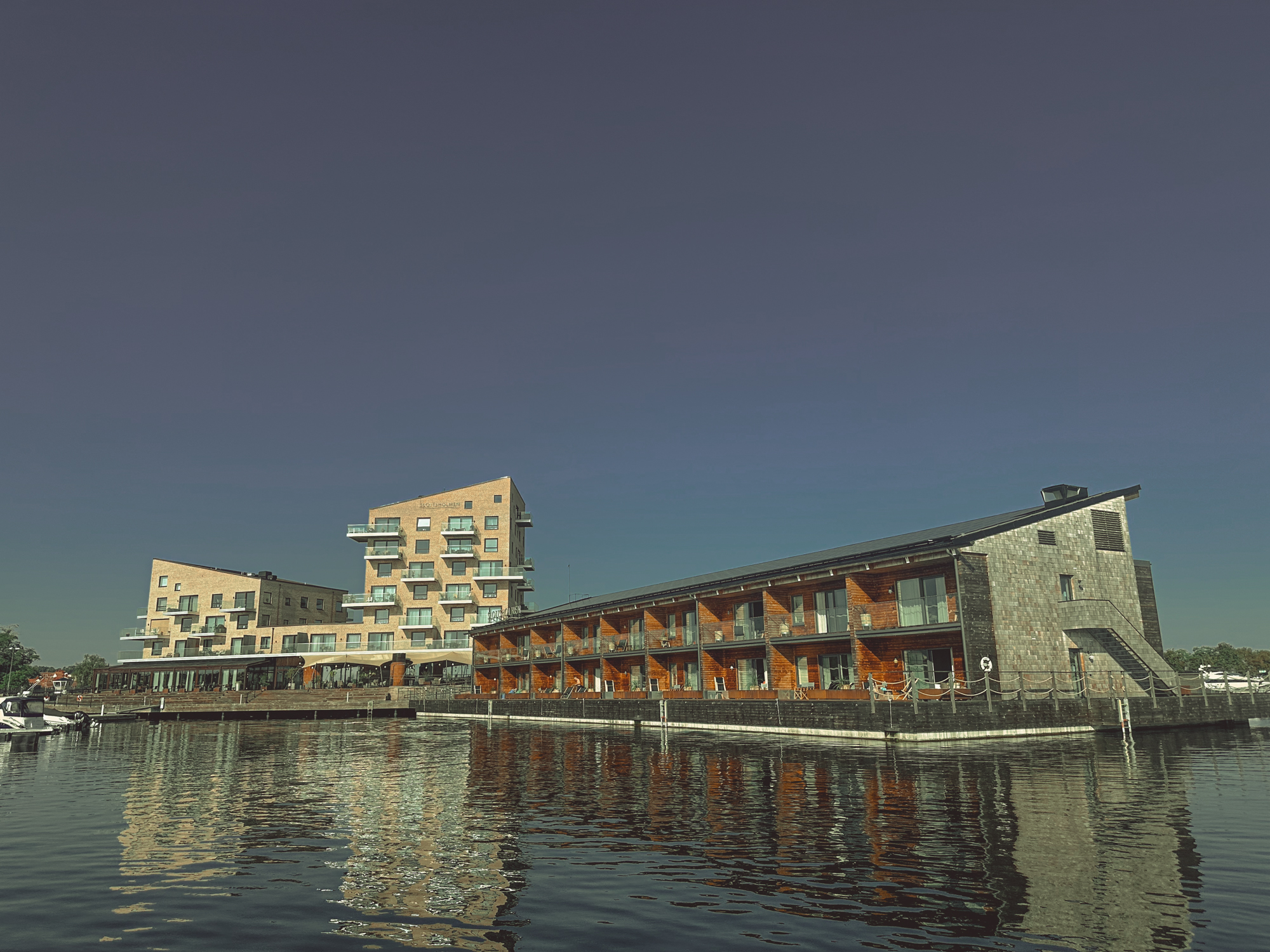
A compelling example of how systemic change can support individual responsibility comes from Sweden – Västervik’s Smart Water Marina System to be implemented under the ECOMARINAS Project (launch planned for 2027).
During summer, Västervik, a popular sailing destination, faces acute water shortages. Seasonal influxes of boats and tourists caused spikes in freshwater consumption, straining local supplies. Therefore, the marina introduced a simple yet effective system: water metering and pricing, similar to electricity billing. Instead of unlimited access, sailors pay for the exact amount of freshwater they use as digital meters track consumption at each berth.
The investment is hoped to have an immediate impact, with sailors becoming more aware of their consumption. Behavioural change is often caused by full understanding and transparency of the system – when people see and pay for each litter, waste decreases. This approach aligns economic incentives with environmental responsibility, making conservation a shared effort between marina operators and sailors.
Today saving water matters more than ever
Reducing freshwater use in sailing brings a range of interconnected benefits that extend far beyond the boat itself. It helps mitigate local water stress, particularly in coastal and lake regions where demand peaks during the sailing season and natural resources are already under pressure. At the same time, using less water means generating less wastewater, especially greywater, which lowers the risk of pollution and reduces the burden on treatment systems. This, in turn, has an important energy dimension: every litter of water saved decreases the energy required for pumping, heating, and treatment, contributing to lower energy usage. Finally, conscious water management fosters greater awareness and resilience among sailors, equipping them with practical skills that are essential during longer voyages or in situations where resources are limited.
A cultural shift in sailing
Sailing has always been closely tied to nature. Today, that relationship must evolve into active stewardship. Water conservation is not a limitation – it is a skill, much like navigation or sail trim.
By understanding the full cycle of water, from source to use to wastewater, we can make more informed decisions onboard and ashore. Whether through personal habits or systemic solutions like those planned in Västervik, every action contributes to a larger change.
Sailing is not just about moving across water. It is about respecting the systems that sustain it – today and for future generations.
--------------------------------------------------------------------------------------------------------------------------------------------
Sources:
European Commission; https://environment.ec.europa.eu/topics/water/water-wise-eu/poland_en?utm
European Environment Agency (EEA); https://www.eea.europa.eu/en/europe-environment-2025/thematic-briefings/biodiversity-and-ecosystems/water-and-climate-impacts
World Bank data; https://data.worldbank.org/indicator/ER.H2O.INTR.PC?locations=PL-EU&utm